


Jade vs Peridot: What's the Difference?
, by Karmasoul, 7 min reading time
, by Karmasoul, 7 min reading time
In the vast kingdom of natural earth minerals, the color green has always held a sacred, almost magnetic hold over human consciousness. It represents the unchecked vitality of the wild forest, the deep roots of the ancient earth, and the quiet internal sanctuary we crave in a chaotic world. However, when building an intentional jewelry collection, navigating the vibrant spectrum of this green gemstone family can get surprisingly complex. Two of the most frequently compared stones in the conscious fashion space are Jade and Peridot. Both present gorgeous variations of moss, lime, and olive hues, leading many to search for jade vs peridot to understand their hidden differences. Are they related? Why does one flash like glass under neon lights while the other holds a heavy, comforting satin warmth? Let's peel back the layers of these two earth protectors to find out which unique frequency resonates with your daily life.
In the vast kingdom of natural earth minerals, the color green has always held a sacred, almost magnetic hold over human consciousness. It represents the unchecked vitality of the wild forest, the deep roots of the ancient earth, and the quiet internal sanctuary we crave in a chaotic world. However, when building an intentional jewelry collection, navigating the vibrant spectrum of this green gemstone family can get surprisingly complex.
Two of the most frequently compared stones in the conscious fashion space are Jade and Peridot.
Both present gorgeous variations of moss, lime, and olive hues, leading many to search for jade vs peridot to understand their hidden differences. Are they related? Why does one flash like glass under neon lights while the other holds a heavy, comforting satin warmth? Let's peel back the layers of these two earth protectors to find out which unique frequency resonates with your daily life.
The confusion between peridot vs jade stems from our shared cultural history. For millennia, ancient traders labeled almost any highly saturated green rock brought along trade routes as "jade" or "emerald" without the aid of modern gemological tools.
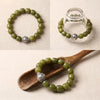
Furthermore, the confusion becomes deeply intertwined when we introduce Olive Jade—a modern variety of jade highly celebrated for its organic, golden-green undertones that closely mimic the natural palette of peridot. Despite their visual harmony, these two stones are forged under entirely separate geological conditions, resulting in completely different optical behaviors, structural weight, and style expressions.
| Feature | Jade (Specifically Olive Jade) | Peridot |
|---|---|---|
| Color Matrix | Muted moss, warm olive, soft sage tones | Vibrant lime, golden-green, olive-chartreuse |
| Transparency | Translucent to completely opaque | High transparency to translucent |
| Mineral Group | Serpentine / Microcrystalline Silicate | Gem-quality Olivine (Magnesium Iron Silicate) |
| Luster / Shine | Soft, velvety, waxy satin glow | Vitreous, sharp, glass-like reflective sparkle |
| Mohs Hardness | 4.0 to 5.5 (Highly shock-resistant toughness) | 6.5 to 7.0 (Hard but prone to internal stress) |
| Price Range | Accessible everyday luxury, sustainable | Mid-to-high tier depending on carat clarity |
| Geological Origin | Metamorphic deep earth crust | Formed in mantle magma (and volcanic meteorites) |
| Jewelry Style | Matte or polished beads, heavy daily bracelets | Faceted rings, delicate studs, minimalist luxury pendants |
When inspecting jade vs peridot side by side under natural daylight, the difference lies in how they radiate color.
Olive Jade features an incredibly soft, rich, and grounding palette. It leans away from blinding brilliance, offering a creamy or velvety matrix intertwined with delicate, dark iron lines and organic forest clouding. It acts as a visual shield—understated, highly private, and soothing to an overstimulated gaze.
Peridot is one of the very few gemstones that exists in only one color: olive-green. However, unlike olive jade, peridot is famous for its crisp, electric, and almost neon brilliance. Because it is highly transparent and faceted by jewelers, it traps light and bounces it outward in double-refracted flashes, making it look incredibly vibrant, sharp, and sun-kissed.
The elemental birthplaces of these minerals give them their unique physical personalities:
On the Mohs Hardness Scale, peridot ranks slightly higher at a 6.5 to 7.0, meaning it is highly resistant to superficial scratches from dust or everyday fabrics. Olive Jade sits slightly lower, usually between 4.0 and 5.5.
However, true everyday durability is about more than just a scratch scale; it is about toughness (the ability to resist breaking). Peridot has a brittle crystalline structure with distinct cleavage planes, meaning a sudden hard knock against a granite countertop can cause it to split or crack. Olive Jade possesses a dense, interlocked fibrous matrix. This unique organic composition makes it incredibly shock-absorbent—it won't easily chip or shatter if you accidentally bump your wrist while typing or moving throughout a busy day.
How you choose to wear your green minerals depends heavily on your daily routine and structural style.
No. Peridot is an independent gemstone variety belonging to the olivine mineral family. Jade belongs to the silicate pyroxene or serpentine groups. They are mineralogically distinct, even if they share beautiful shades of olive.
While Olive Jade shares a nearly identical golden-moss palette and is frequently referred to in historical texts alongside olivine minerals due to its appearance, it is a separate, dense metamorphic stone. It provides the same comforting visual therapy as peridot but in a smoother, more durable, bead-ready form.
Peridot is harder to scratch, but Olive Jade is harder to break. If you tend to drop your jewelry or lead an active, hands-on lifestyle, Olive Jade’s shock-absorbent structure makes it far safer for daily wear.
Olive Jade is undeniably superior for daily beaded bracelets. Its heavy, silky, rounded texture feels soothing against the skin, and its structural toughness ensures it can handle the repetitive bumps of daily life without fracturing.
Ready to anchor your nervous system in true organic luxury? Explore our signature Olive Jade Collection to discover pieces crafted explicitly for modern grounding, or reinforce your everyday aura with our curated Protection Collection.