


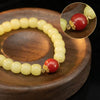
Jade vs Emerald: What's the Difference?
, by Karmasoul, 7 min reading time
, by Karmasoul, 7 min reading time
When it comes to the world of fine jewelry and personal talismans, green is more than just a color—it is a statement of life, vitality, and deep alignment. For centuries, two iconic titans have dominated this landscape: Jade and Emerald. At a fleeting glance, both present a breathtaking wash of forest hues, leading many modern jewelry lovers to wonder about jade vs emerald and how they truly differ. Yet, stepping closer reveals that these two stones belong to entirely different worlds. One is a crystalline window of sharp, flashing light; the other is a soft, velvety shield of protective earth energy. Whether you are seeking a striking statement piece or a grounded everyday companion, understanding the distinct signatures of these two legendary green gemstone varieties is essential.
When it comes to the world of fine jewelry and personal talismans, green is more than just a color—it is a statement of life, vitality, and deep alignment. For centuries, two iconic titans have dominated this landscape: Jade and Emerald.
At a fleeting glance, both present a breathtaking wash of forest hues, leading many modern jewelry lovers to wonder about jade vs emerald and how they truly differ. Yet, stepping closer reveals that these two stones belong to entirely different worlds. One is a crystalline window of sharp, flashing light; the other is a soft, velvety shield of protective earth energy.
Whether you are seeking a striking statement piece or a grounded everyday companion, understanding the distinct signatures of these two legendary green gemstone varieties is essential.
The confusion between emerald vs jade is deeply rooted in our sensory perception. Green is the rarest color family in the mineral kingdom, and both stones exhibit a rich saturation that instantly commands attention.
Historically, ancient civilizations often used generic cultural terms to describe any mesmerizing green stone found in the earth. However, beneath the surface lies a fundamental division in crystal structure, geological age, and cultural philosophy. While an emerald screams with high-society luxury and external brilliance, jade hums with a quiet, continuous internal harmony.
| Feature | Jade (Nephrite / Jadeite) | Emerald |
|---|---|---|
| Color Spectrum | Moss green, lavender, white, warm olive | Vibrant bluish-green to deep forest green |
| Mineral Composition | Sodium Aluminum Silicate or Magnesium Iron Silicate | Beryllium Aluminum Silicate (Beryl family) |
| Transparency | Semi-translucent to completely opaque | Highly transparent to translucent |
| Mohs Hardness | 6.0 to 7.0 (Incredibly tough interlocking structure) | 7.5 to 8.0 (Hard but structurally brittle) |
| Luster / Shine | Soft, velvety, oily, or waxy satin glow | Vitreous, sharp, glass-like reflective sparkle |
| Price Range | Highly accessible everyday luxury to collector heirlooms | Premium luxury; highly expensive per carat |
| Symbolism | Harmony, calm wisdom, emotional balance | Love, personal growth, abundance, luxury |
| Lifestyle Wear | Ideal for 24/7 everyday wear and active lifestyles | Best reserved for conscious wear and evening events |
The aesthetic experience of wearing jade vs emerald comes down to how each mineral interacts with light.
An emerald behaves like an intricate web of mirrors. Because it belongs to the beryl mineral family, high-quality emeralds possess crystal-clear transparency. When light hits a faceted emerald, it plunges deep into the stone, reflecting off its internal facets to create a sharp, dramatic sparkle. It is vibrant, unapologetic, and brilliantly intense.
Jade does not sparkle; it glows. Its beauty lies in its dense, microcrystalline texture, which diffuses light rather than reflecting it sharply. Instead of a glassy shine, jade features a smooth, liquid-like, or waxy luster that warms slowly to your unique body temperature. It feels incredibly soothing against the skin, offering an intimate aesthetic meant for the wearer rather than the crowd.
One of the most surprising twists in the green gemstone debate is the difference between mineral hardness and structural toughness.
The financial investment required for jade vs emerald highlights their differing market dynamics.
Choosing between these stones is ultimately an exercise in identifying what your aura currently craves:
Long associated with the heart chakra, the vibrant green of the emerald symbolizes open-hearted vulnerability, deep romantic love, and personal expansion. It acts as an energetic magnet for manifestation, wealth, and abundance, pushing you to step into your highest power and claim your space in the world.
Jade operates on a completely different frequency, focusing entirely on internal alignment. It is the ultimate stone of emotional grounding, helping to filter out the chaotic digital noise of modern life. Wearing jade serves as a silent, physical anchor that promotes ancient wisdom, self-compassion, and a deep state of nervous system harmony.
It depends on the variety. Fine, transparent Jadeite from Myanmar is exceptionally rare and rivals the cost of the finest emeralds. However, beautiful Nephrite and Serpentine jades are more abundant across the globe, making them far more sustainable and accessible for everyday intentional jewelry.
It is not recommended for high-impact activities. While a jade bracelet can handle everything from yoga to typing on a laptop, an emerald ring or bracelet requires careful protection from harsh detergents, gardening, or rough physical contact due to its internal brittleness.
Jade has high thermal conductivity. When you first pick it up, it rapidly draws heat away from your skin, feeling beautifully icy and refreshing. Over a few minutes, it mirrors your exact body heat, creating an intimate somatic bond between the wearer and the stone.
Ready to anchor your nervous system in true green harmony? Dive into our serene Balance Collection to discover signature everyday jade designs, or amplify your spiritual shields with our curated Protection Collection.