


Jade vs Aventurine: How to Tell the Difference
, by Karmasoul, 7 min reading time
, by Karmasoul, 7 min reading time
When building a meaningful jewelry collection or searching for a daily grounding talisman, green earth materials are always at the top of the list. They carry a timeless bio-resonance that immediately evokes feelings of growth, centering, and calm. However, as you explore the market for the perfect green beaded accent, you will inevitably run into two stones that look remarkably alike at first glance: Jade and Aventurine. Because of their overlapping mossy palettes, beginners often struggle to navigate the jade vs aventurine debate. You might wonder: Why is there such a price difference? How can I verify what I'm wearing? And which stone truly aligns with my lifestyle? Let’s dismantle the confusion once and for all with this definitive, practical guide to separating these two captivating green minerals.
When building a meaningful jewelry collection or searching for a daily grounding talisman, green earth materials are always at the top of the list. They carry a timeless bio-resonance that immediately evokes feelings of growth, centering, and calm. However, as you explore the market for the perfect green beaded accent, you will inevitably run into two stones that look remarkably alike at first glance: Jade and Aventurine.
Because of their overlapping mossy palettes, beginners often struggle to navigate the jade vs aventurine debate. You might wonder: Why is there such a price difference? How can I verify what I'm wearing? And which stone truly aligns with my lifestyle?
Let’s dismantle the confusion once and for all with this definitive, practical guide to separating these two captivating green minerals.
The visual overlap between aventurine vs jade is one of the most common stumbling blocks in the modern gemstone space.
Both minerals display an array of beautiful, soothing forest greens, sage tones, and milky mint translucent finishes. Historically, aventurine has even been playfully nicknamed "Indian Jade" or "Australian Jade" by traders to capitalize on jade's ancient prestige. Despite their superficial similarities, they belong to completely distinct mineral families born from entirely separate geological processes.
Mistaking one for the other is incredibly easy until you learn exactly what optical clues to look for beneath the surface.
| Feature | Jade (Nephrite / Jadeite / Serpentine) | Green Aventurine |
|---|---|---|
| Color Matrix | Smooth, uniform greens, lavender, creamy white | Translucent medium-to-dark green with shimmering flecks |
| Visual Texture | Seamless, velvety, cloud-like organic structures | Grainy quartz matrix packed with tiny mica inclusions |
| Mineral Group | Silicate/Pyroxene interlocking fibers | Macrocrystalline Quartz (with Fuchsite Mica) |
| Transparency | Semi-translucent to opaque (Soft interior glow) | Semi-translucent (Light passes through quartz grains) |
| Price Spectrum | Highly flexible; accessible modern jades to elite luxury | Consistently affordable and budget-friendly global mineral |
| Optical Effect | Waxy, oily, liquid-like satin polish | Aventurescence (Internal metallic sparkle or glitter) |
The absolute easiest way to settle the jade vs aventurine mystery is by holding the stone under direct sunlight or a bright smartphone flashlight.
Green aventurine is a form of quartz. What makes it spectacular is a unique optical phenomenon called aventurescence. Inside a green aventurine bead, there are microscopic plates of a green chromium-rich mica called fuchsite. When light hits these flecks, they act like tiny cosmic mirrors, causing the stone to glisten, shimmer, and sparkle from the inside out. If your stone has a subtle "glitter" effect, it is unmistakably aventurine.
Jade behaves with a quiet elegance. It does not contain metallic flakes or starry glitter. Instead, its surface presents a perfectly smooth, uniform, or swirling cloud-like pattern. Jade is celebrated for its soft, velvety, or "greasy" luster. Rather than reflecting sharp sparks of light, it diffuses light internally, creating a deeply comforting, soft liquid glow.
Both stones are exceptionally tough and highly suited for daily movement, but their mineral structures protect them differently:
Because both minerals offer great durability, they are widely utilized across modern metaphysical and casual styles.
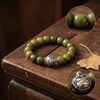
An aventurine bracelet is highly popular in modern bohemian or high-contrast street style due to its playful sparkle and accessible price point. On the other side, an olive jade or nephrite bracelet offers a heavier, silkier weight on the wrist, making it a beautiful tactile device for self-soothing rituals during long workdays.
Aventurine is frequently carved into raw, geometric crystals or trendy boho pendants. Jade is traditionally reserved for smooth cabochons, seamless comfort-fit rings, and minimalist discs that honor its liquid texture. Both stones resist water and daily sweat beautifully, making them excellent choices for 24/7 "second-skin" accessories.
The decision between jade vs aventurine ultimately comes down to two major personal filters: your budget and your visual style.
No. While it is frequently used as an alternative to jade due to its look and affordability, green aventurine is a quartzite mineral, whereas jade consists of either nephrite or jadeite structures. They are completely different rock families.
Generally, yes. Aventurine is highly abundant across India and Brazil, making it exceptionally budget-friendly. Authentic traditional jade can get very expensive, though modern variations like Olive Jade offer an excellent middle ground—bringing you true jade texture at a highly accessible price point.
Yes, absolutely. Its high Mohs hardness of 7 means it can withstand workouts, showering, and daily errands. Just avoid dropping it onto hard tile floors from high distances to prevent the crystalline quartz from splitting.
Natural green aventurine will not fade or change color under normal conditions. However, prolonged exposure to extreme industrial chemicals or intense artificial UV tanning beds should be avoided to protect its natural mica inclusions.
Ready to realign your personal frequencies? Explore our shimmering Protection Collection to find protective everyday wearables, or step into absolute center with our soothing Balance Collection.